WhatsApp Charges Change: Businesses Face New Costs
 BYM Digital
•
September 8, 2026
•
7 min read
BYM Digital
•
September 8, 2026
•
7 min read
🚨 WhatsApp Business Pricing Is Changing: What Indian Businesses Need to Know Before October 1, 2026
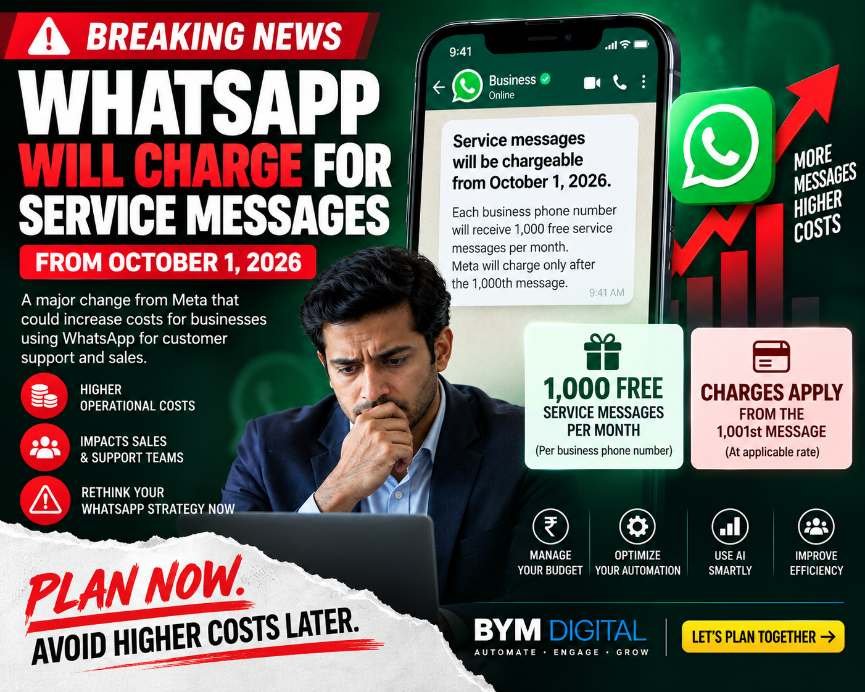
WhatsApp Business users have a major pricing change to prepare for. Starting October 1, 2026, Meta will introduce per-message charges for service messages. The change could affect businesses that depend heavily on WhatsApp for customer support, CRM, lead management and automated conversations.
The good news is that Meta is introducing a 1,000 free service-message allowance every month for each business phone number. The bad news is that once that monthly allowance is exhausted, additional service messages will be chargeable at the applicable market rate.
For businesses running high-volume WhatsApp CRM or customer-support operations, this means WhatsApp messaging costs need to become part of the monthly automation budget.
🚨 What Is Changing From October 1, 2026?
Meta's updated pricing structure will charge businesses for service messages on a per-message basis. The applicable service-message rate will be aligned with the relevant market's utility/authentication pricing structure.
At the same time, Meta will provide 1,000 free service messages every month for each business phone number. These messages reset monthly and unused messages do not roll over.
- Effective date: October 1, 2026
- New pricing model: Service messages charged per message after the free allowance
- Monthly free allowance: 1,000 service messages per business phone number
- Unused allowance: Does not roll over
- Reset: Every month
- 24-hour service window: Still applies
Why This Is Serious for WhatsApp-First Businesses
For a small business handling a few hundred customer conversations every month, the 1,000-message allowance may be sufficient.
For a business handling thousands or tens of thousands of customer interactions, however, the calculation changes significantly.
Think about a business receiving hundreds of leads every day. Each customer may send multiple questions, and the sales or support team may respond several times. At scale, service messages can quickly move beyond the free monthly allowance.
This makes message-volume management and WhatsApp automation efficiency more important than ever.
WhatsApp Pricing: Before vs After October 1
| Area | Before October 1, 2026 | From October 1, 2026 |
|---|---|---|
| Service messages | Free under the current model | Per-message pricing applies |
| Free service messages | Current model | 1,000 per month per business phone number |
| Unused free messages | N/A | Do not roll over |
| Free quota reset | N/A | Monthly |
| 24-hour customer service window | Applies | Still applies |
| Messages beyond free allowance | Not applicable under current service-message model | Charged at applicable rate |
📱 The 1,000-Free-Message Rule Explained
The new rule is simple but important.
Imagine a business phone number sends 800 service messages during October. Those messages would remain within the monthly free allowance.
If the same number sends 1,500 service messages, the first 1,000 fall within the free allowance and the remaining 500 become chargeable at the applicable rate.
The allowance is attached to the business phone number, and unused messages disappear when the monthly period resets.
⚠️ What Businesses Should Not Assume
There is an important distinction between service messages, utility messages and marketing messages. Businesses should not assume that the 1,000-message allowance makes all WhatsApp communication free.
Marketing messages remain subject to their applicable pricing. Utility messages also have their own pricing rules. Businesses should therefore classify their WhatsApp communication correctly and monitor Meta's current pricing schedule.
Meta's WhatsApp Business policies also state that businesses can respond to users without a message template during the 24-hour customer-service window following the user's message. Automated responses are permitted during that window, subject to WhatsApp's policies and appropriate escalation options. 0
💰 Example: How Costs Can Change
Consider a business that uses WhatsApp for customer support and receives a large number of enquiries every month.
- Monthly service messages: 5,000
- Free monthly allowance: 1,000
- Potential chargeable service messages: 4,000
- Applicable rate: Depends on Meta's current market pricing and message classification
The exact amount a business pays will depend on the applicable Meta rate and message classification. The important point is that high-volume businesses can no longer treat service messaging as an unlimited free resource.
Why WhatsApp CRM Strategy Now Matters More
This change makes efficient WhatsApp CRM architecture increasingly important.
A poorly designed automation system may generate unnecessary messages, duplicate replies, repetitive notifications and inefficient follow-ups. A well-designed system can reduce unnecessary communication while ensuring that important customer interactions are handled quickly.
Businesses should focus on:
- Reducing unnecessary automated replies
- Preventing duplicate messages
- Using AI to understand customer intent
- Routing complex conversations to human agents
- Maintaining clean CRM data
- Tracking message volumes by business phone number
- Monitoring monthly service-message usage
- Reviewing message categories regularly
🤖 AI + WhatsApp Automation Could Become More Important
The pricing change could accelerate the adoption of smarter WhatsApp automation.
Instead of sending multiple generic messages, businesses can use AI to understand what the customer actually needs and provide a more targeted response.
A modern workflow could look like:
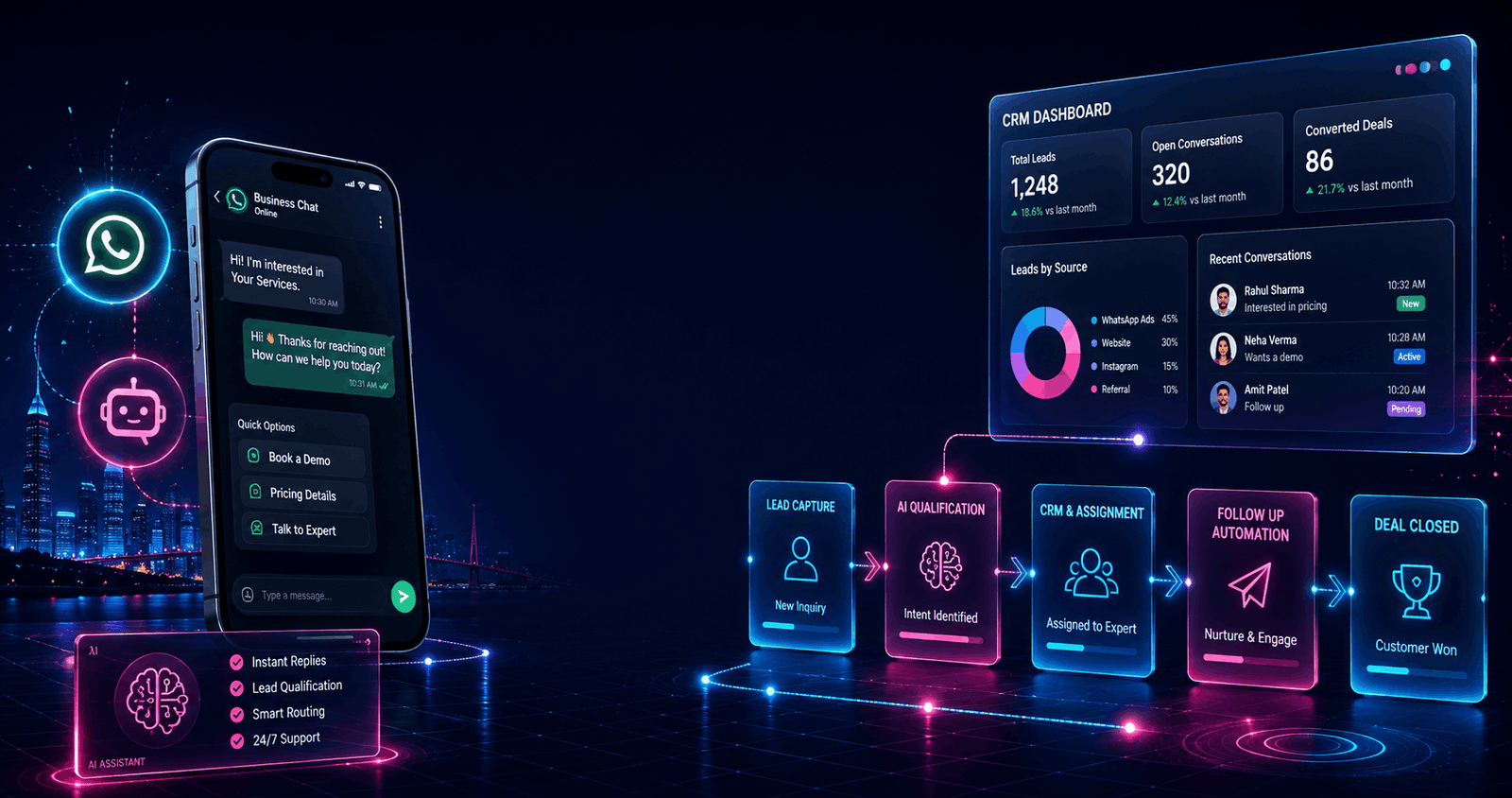
- Lead enters through an advertisement or website.
- Customer starts a WhatsApp conversation.
- AI understands intent.
- CRM identifies the customer.
- AI provides the relevant response.
- Lead is qualified automatically.
- High-value leads are transferred to a salesperson.
- Follow-ups are triggered intelligently.
The objective is not to send more messages. The objective is to make every message more useful.
🚨 What Indian Businesses Should Do Before October 1
Businesses using WhatsApp at scale should start preparing before the pricing change becomes effective.
- Audit your current WhatsApp message volume.
- Separate marketing, utility and service communication.
- Calculate how many service messages each phone number generates.
- Identify unnecessary automated replies.
- Review your WhatsApp CRM workflows.
- Measure the number of messages generated per lead.
- Introduce AI qualification where appropriate.
- Create monthly message-cost reporting.
How BYM Digital Can Help
For businesses that depend on WhatsApp for sales, support and CRM, this pricing change is a good reason to review the entire customer communication strategy.
BYM Digital helps businesses build WhatsApp automation, AI-powered lead qualification, CRM workflows and customer journeys designed around business objectives—not unnecessary message volume.
Our approach is simple: automate intelligently, reduce repetitive communication and make every customer interaction count.
Explore WhatsApp Automation by BYM Digital to see how your business can build a more efficient WhatsApp CRM workflow.
If you're concerned about how the October 1 pricing change could affect your WhatsApp costs, contact BYM Digital for a WhatsApp automation and CRM assessment.
Frequently Asked Questions
Will WhatsApp service messages become paid from October 1, 2026?
Yes. Meta has announced that service messages will move to per-message pricing from October 1, 2026, with a monthly allowance of 1,000 free service messages per business phone number.
How many free WhatsApp service messages will businesses get?
Each business phone number will receive 1,000 free service messages per month. Unused messages do not roll over to the following month.
What happens after 1,000 free service messages?
Once the monthly 1,000-message allowance is exhausted, additional service messages will be charged at the applicable Meta rate for that market and message classification.
Will the WhatsApp 24-hour customer service window change?
No. The 24-hour customer-service window continues to apply. Businesses can respond during the open window, subject to WhatsApp's applicable policies.
🚨 Final Warning for WhatsApp-Dependent Businesses
October 1, 2026 is an important date for every business using WhatsApp at scale.
The introduction of per-message service pricing means businesses need greater visibility into their WhatsApp communication costs. The 1,000 free monthly messages provide protection for lower-volume businesses, but companies handling thousands of conversations need to understand exactly how many messages their automation generates.
This is not simply a pricing update. It is a signal that WhatsApp CRM strategy, automation efficiency and message management are becoming increasingly important to the cost of customer acquisition and support.
Businesses that audit their workflows now can prepare before the new pricing takes effect—and potentially eliminate thousands of unnecessary messages in the process.