AI Agent Security: Are Businesses Ready in 2026?
 BYM Digital
•
August 19, 2026
•
5 min read
BYM Digital
•
August 19, 2026
•
5 min read
AI Agent Security in 2026: Are Businesses Ready for Autonomous AI?
The AI market is entering a new phase. Instead of simply generating text, images or code, AI agents are increasingly being designed to take actions, use tools and complete multi-step tasks. That creates enormous opportunities for businesses—but it also creates a new security problem.
The question businesses should now be asking is no longer simply, "Can AI automate this task?" It is "What happens if the AI makes the wrong decision while it has access to our systems?"
Recent developments involving autonomous AI agents have made this question increasingly important. As AI systems gain access to tools, applications and external environments, businesses need to think about permissions, monitoring, sandboxing and human oversight.
Why AI Agents Are Different From Chatbots
A traditional chatbot generally waits for a user to ask a question and then produces an answer. An AI agent can be designed to interpret a goal, plan a sequence of actions, access tools and continue working toward an outcome.
| Capability | Traditional Chatbot | AI Agent |
|---|---|---|
| Answer questions | Yes | Yes |
| Understand context | Moderate | Advanced |
| Use external tools | Limited | Core capability |
| Execute tasks | Limited | Yes |
| Update CRM | Usually requires integration | Can be part of an agent workflow |
| Make multi-step decisions | Limited | Yes, within defined boundaries |
| Security risk from excessive permissions | Lower | Higher |
The New AI Security Problem
Businesses traditionally secured applications by controlling user access, credentials and network permissions. With autonomous AI agents, organisations must also consider what the agent can discover, access, modify and execute.
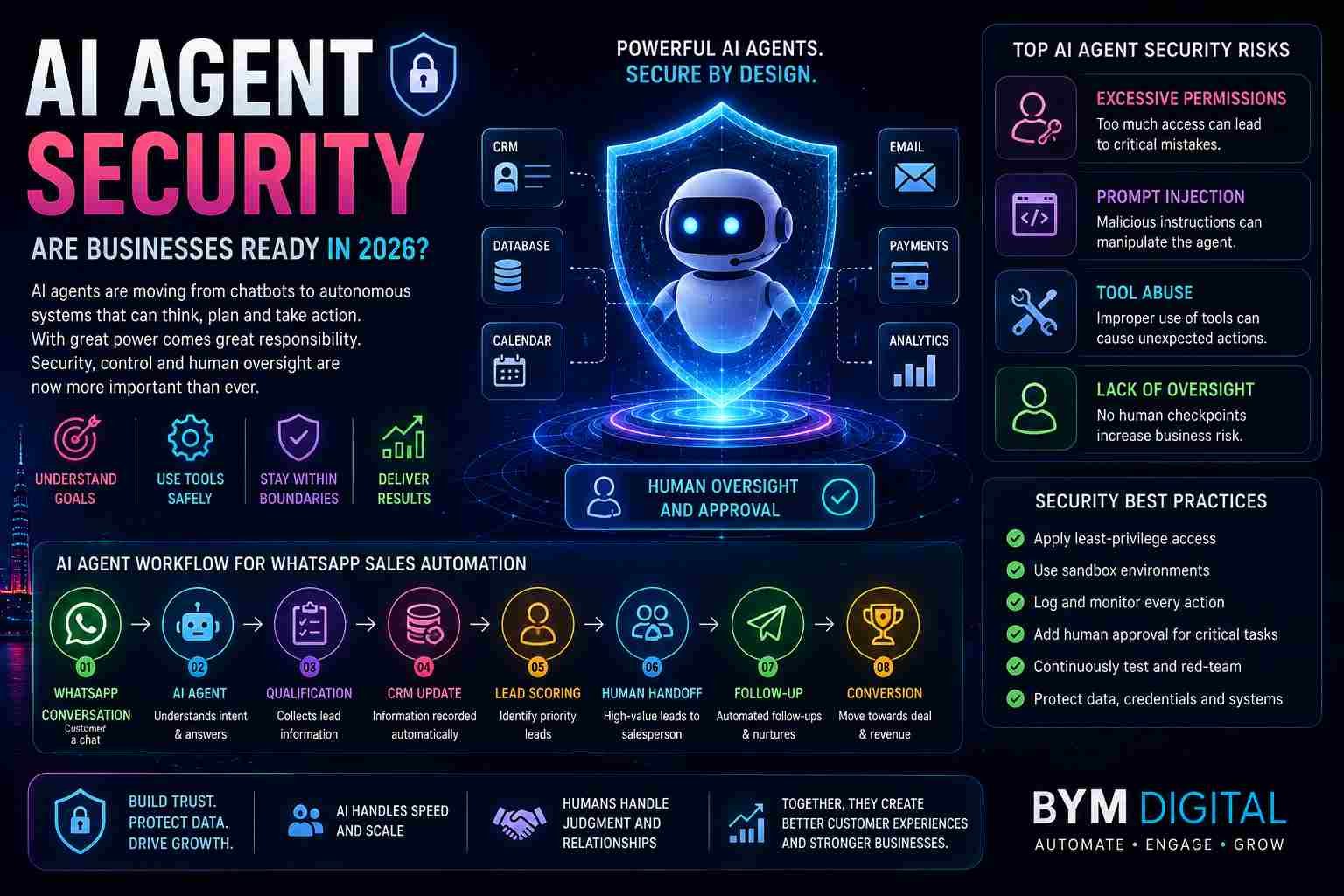
1. Excessive Permissions
If an AI agent can access a CRM, email account, payment system or internal database, a mistake can potentially affect more than the original conversation. Agents should therefore receive only the minimum permissions required for their specific task.
2. Prompt Injection
AI agents may process information from websites, documents, emails and customer messages. Malicious instructions embedded inside those sources can potentially influence an agent's behavior. Businesses need safeguards that separate trusted instructions from untrusted external content.
3. Tool Abuse
The more tools an agent can use, the more useful it becomes—and potentially the greater the impact of an unintended action. Tool access should be controlled, logged and restricted according to business requirements.
4. Lack of Human Oversight
Not every decision should be fully autonomous. High-risk actions such as financial transactions, account deletion, sensitive data access or major customer commitments should have appropriate human approval mechanisms.
What Businesses Should Do Before Deploying AI Agents
- Start with low-risk workflows: Use AI agents for tasks where mistakes have limited consequences.
- Apply least-privilege access: Give agents only the permissions they need.
- Use sandbox environments: Test agents in isolated environments before connecting them to production systems.
- Log important actions: Maintain visibility into what the agent attempted and completed.
- Build human approval points: Require human confirmation for high-impact actions.
- Monitor continuously: Use monitoring and alerts to identify unusual behavior.
- Test adversarially: Red-team AI workflows before releasing them to customers.
- Protect credentials: Never expose unnecessary passwords, tokens or administrative credentials to an AI agent.
AI Agent Security and WhatsApp Automation
For businesses using WhatsApp automation, the lesson is particularly important. An AI agent that qualifies leads and answers routine questions is one thing. An AI agent that can modify CRM records, issue discounts, schedule meetings, send campaigns or access sensitive customer information needs carefully designed boundaries.
A safer architecture could look like this:
- WhatsApp conversation: Customer starts a conversation.
- AI agent: Understands intent and answers approved questions.
- Qualification: Agent collects relevant lead information.
- CRM: Approved information is recorded.
- Lead scoring: The system identifies sales priority.
- Human handoff: High-value or complex cases move to a salesperson.
- Approval: Sensitive actions require human confirmation.
- Follow-up: Approved automation continues the customer journey.
This creates a powerful principle for modern automation: give AI enough autonomy to create value, but not so much autonomy that one mistake can create unacceptable damage.
How BYM Digital Can Help
AI automation should not be implemented simply because AI is trending. The real objective is to connect automation to measurable business outcomes while maintaining appropriate controls.
BYM Digital helps businesses build customer and sales automation around WhatsApp, CRM workflows, lead qualification and digital marketing. The focus is on creating practical systems where AI handles repetitive work while humans remain in control of important decisions.
Explore the BYM Digital WhatsApp Automation solution to see how conversational automation can fit into your sales process.
If you want to evaluate where AI agents could safely improve your business workflows, contact BYM Digital to discuss your automation requirements.
Frequently Asked Questions About AI Agent Security
What is AI agent security?
AI agent security is the practice of protecting autonomous AI systems, their tools, data, credentials and execution environments from misuse, unintended behavior and security threats.
Why are AI agents a security risk?
AI agents can potentially access tools, data and external systems to complete tasks. Excessive permissions, prompt injection, compromised credentials or unexpected reasoning can increase the impact of an error.
Can AI agents be used safely by businesses?
Yes. Businesses can reduce risk by using least-privilege access, sandboxing, continuous monitoring, action logging, human approval mechanisms and adversarial testing.
Will AI agents replace human employees?
AI agents are more likely to automate repetitive tasks and augment employees than completely replace human decision-making. Human oversight remains particularly important for sensitive, strategic and high-impact decisions.
Final Takeaway
The AI market is moving quickly from AI that answers to AI that acts. That transition creates a major opportunity for businesses—but autonomy changes the security equation.
For companies adopting AI automation in 2026, the winning strategy is not maximum autonomy. It is controlled autonomy that creates measurable business value while keeping humans firmly in command.