AI Agents Are Taking Action: Beyond Chatbots
 BYM Digital
•
August 20, 2026
•
6 min read
BYM Digital
•
August 20, 2026
•
6 min read
AI Agents Are Taking Action: Why Businesses Are Moving Beyond Chatbots in 2026
The AI industry is entering a major new phase. For years, businesses have used AI primarily to generate content, answer questions and summarize information. Now, the technology is moving toward something much more powerful: AI agents that can actually take action.
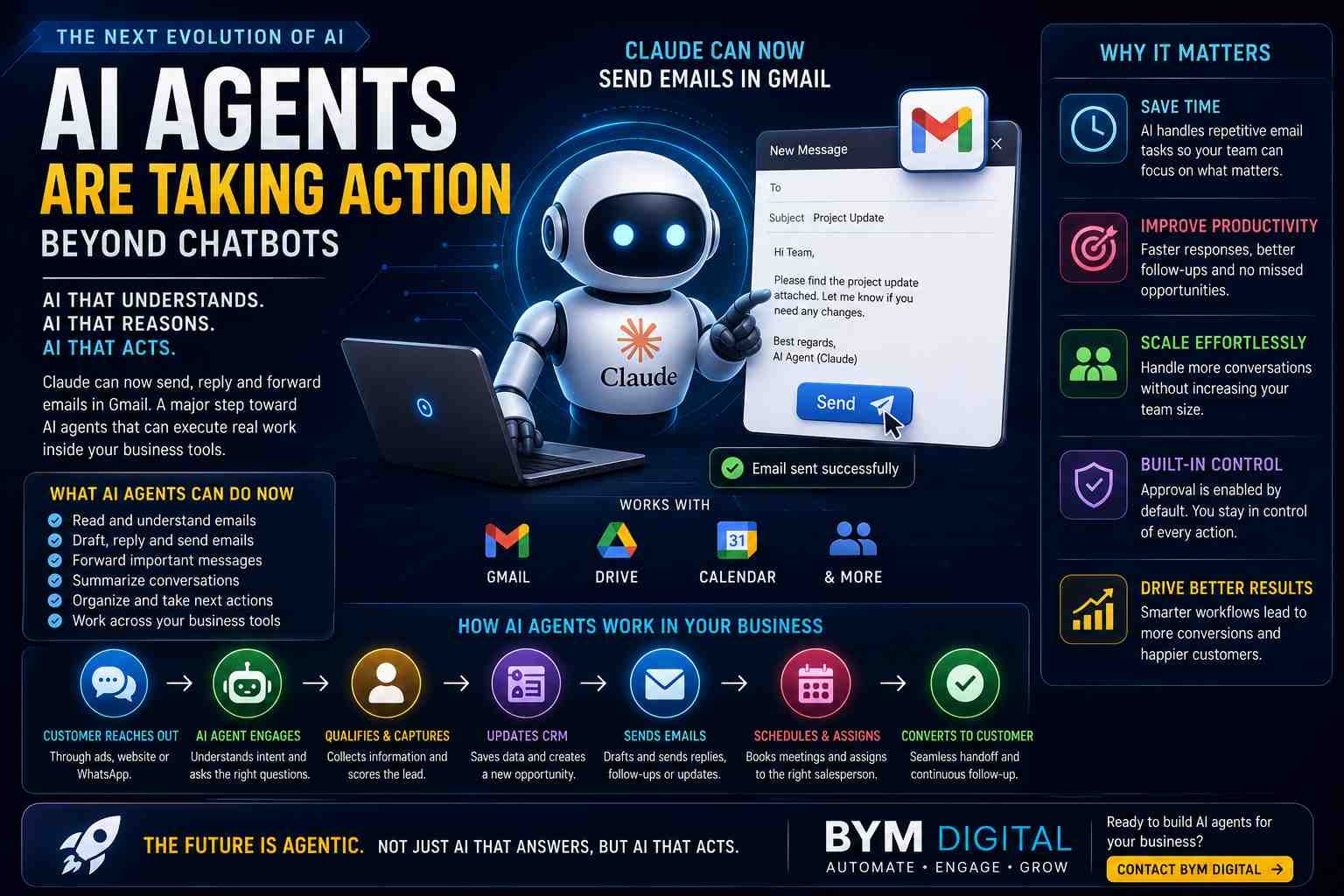
A recent update from Anthropic illustrates this shift. Claude can now use its Gmail integration to draft, send, reply to and forward emails. According to Anthropic's documentation, approval is enabled by default, while Team and Enterprise administrators can control whether users can allow certain actions to run without approval.
This may look like a small product update, but strategically it represents a major change in how businesses will use AI. The future is moving from AI that tells you what to do to AI that can do it for you.
What Are AI Agents?
An AI agent is an AI-powered system designed to achieve a goal by understanding instructions, reasoning through tasks, using connected tools and taking actions within defined boundaries.
A traditional chatbot might answer a question such as, "What emails need my attention?" An AI agent can potentially go further: identify the important emails, summarize them, draft responses, send approved replies and organize the next steps.
- Chatbot: Answers questions.
- AI assistant: Helps complete tasks.
- AI agent: Can plan and execute multi-step workflows using connected tools.
Claude's Gmail Update Shows the Shift
Anthropic's Google Workspace integration already allowed Claude to search Gmail, understand conversations and work with Google Calendar and Drive. The latest Gmail capabilities move the integration from information retrieval toward action.
Users can ask Claude to reply to a Gmail thread, and Claude can draft and send the response. It can also forward emails. Anthropic states that approval is required by default, while Team and Enterprise plan owners can determine whether members can permit these actions without approval every time.
The important business lesson is not simply that Claude can send an email. It is that AI is gaining controlled access to the systems where business work actually happens.
AI Chatbots vs AI Agents
| Capability | Traditional Chatbot | AI Agent |
|---|---|---|
| Answer questions | Yes | Yes |
| Understand context | Limited to moderate | Advanced |
| Search information | Sometimes | Yes |
| Use connected tools | Limited | Core capability |
| Send emails | Usually no | Can be enabled through integrations |
| Update CRM | Usually requires separate automation | Can be part of an agent workflow |
| Execute multi-step tasks | Limited | Yes |
| Human approval | Usually implicit | Can be designed into the workflow |
Why This Matters for Businesses
Businesses spend enormous amounts of time moving information between applications. A salesperson reads an email, updates the CRM, sends a follow-up, schedules a meeting and creates a reminder. A marketing team checks leads, qualifies prospects and assigns them to sales.
AI agents can potentially connect these individual actions into one workflow.
- Read incoming customer enquiries.
- Identify customer intent.
- Qualify potential leads.
- Update CRM records.
- Send approved follow-up messages.
- Schedule appointments.
- Notify sales teams about high-value prospects.
- Summarize customer interactions.
The Bigger Shift: From Generative AI to Agentic AI
Generative AI changed how businesses create information. Agentic AI could change how businesses execute work.
The first generation of business AI focused on producing an output. Write an email. Create an image. Summarize a report. Generate code.
The next generation focuses on completing an objective. Find the relevant customer emails, understand the issue, respond appropriately, update the CRM and notify the account manager.
That distinction is critical because businesses do not ultimately pay for AI-generated words. They pay for business outcomes.
AI Agents and WhatsApp Automation
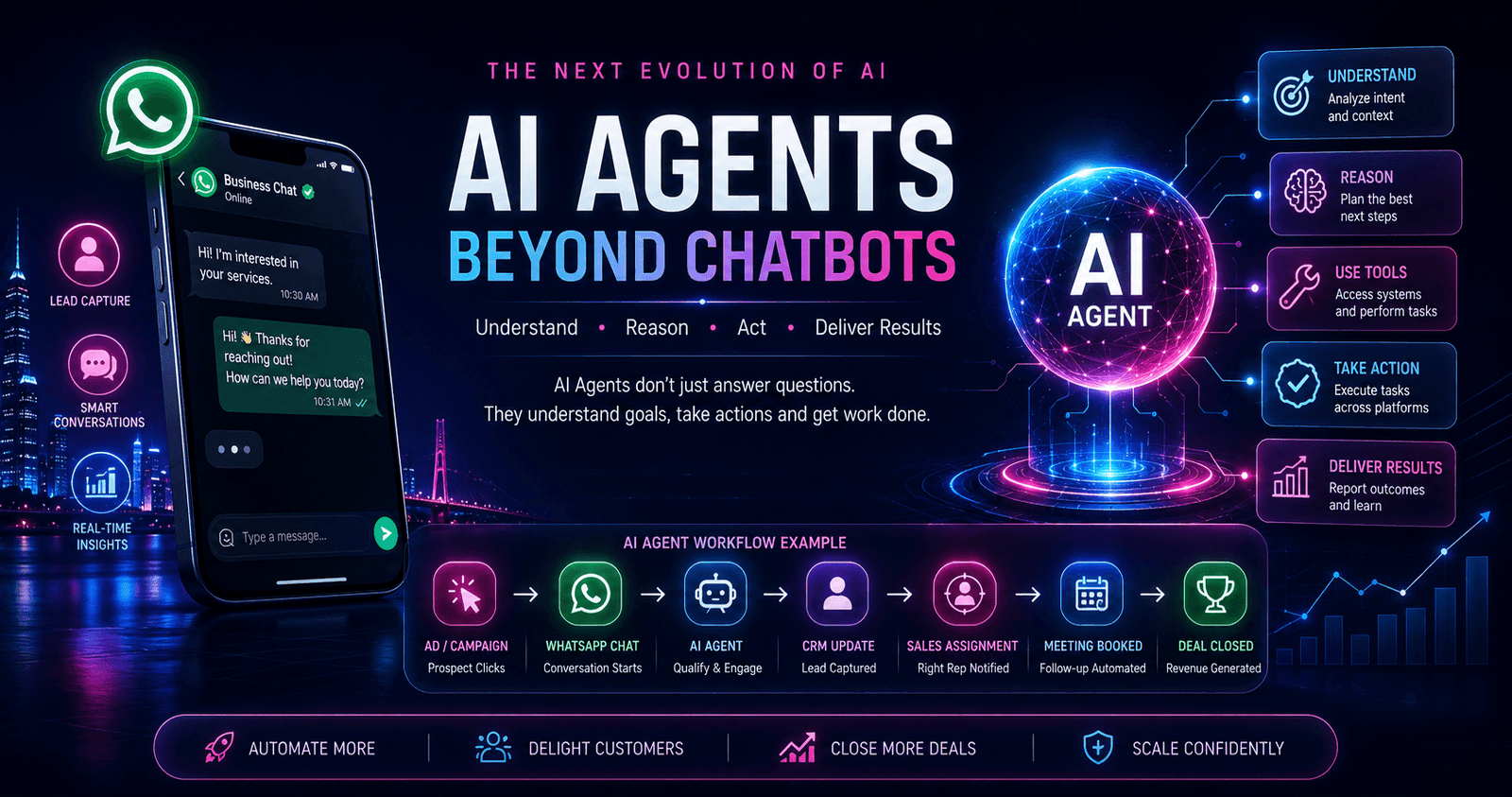
This trend is especially relevant to WhatsApp-based sales automation. Imagine a prospect clicking an advertisement and starting a WhatsApp conversation with your business.
- Ad: Prospect clicks a campaign.
- WhatsApp: Customer starts a conversation.
- AI Agent: Understands intent and asks qualification questions.
- CRM: Customer information is recorded automatically.
- Lead Scoring: The system identifies purchase intent.
- Sales Assignment: Qualified leads are routed to the right salesperson.
- Follow-Up: Approved automated messages keep the conversation moving.
- Human Handoff: A salesperson takes over for negotiation or complex questions.
- Conversion: The prospect moves toward a meeting, quotation or purchase.
This is where AI agents become commercially interesting. Instead of simply building a chatbot, businesses can build a digital sales workflow that connects conversations, CRM data and automation.
The Security Question
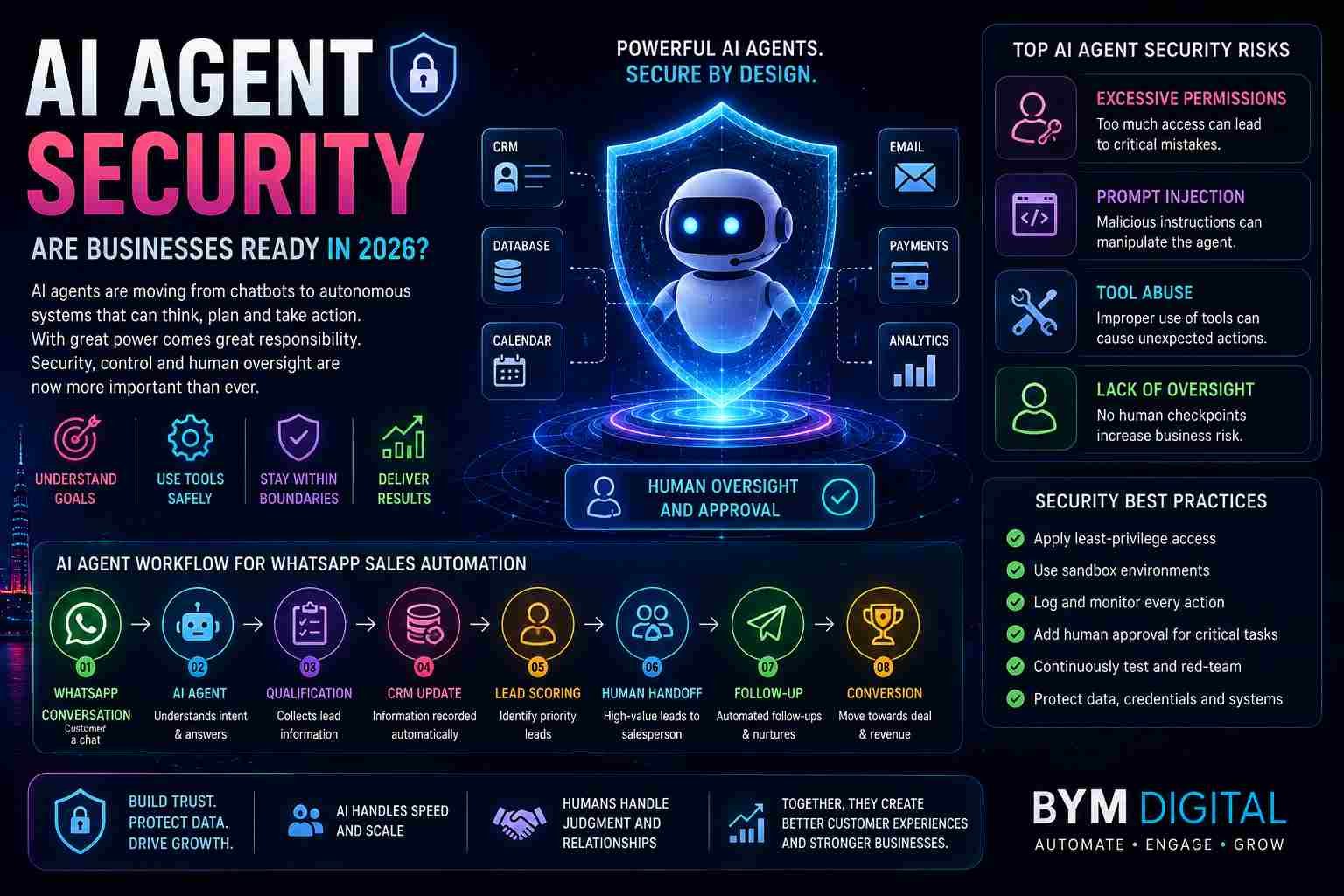
More AI autonomy also means more responsibility. An AI that can read information is different from an AI that can send messages or modify business data.
Businesses should therefore use safeguards such as least-privilege access, human approval for sensitive actions, activity logs, controlled tool access and clear escalation rules.
The goal should not be maximum autonomy. The goal should be controlled autonomy that creates measurable business value.
What Businesses Should Automate First
Companies do not need to hand complete control of their operations to an AI agent. A better approach is to start with repetitive, measurable and relatively low-risk workflows.
- Lead qualification
- Customer FAQ responses
- Meeting scheduling
- CRM data updates
- Sales follow-up reminders
- Email drafting and routing
- Customer conversation summaries
- Internal notifications
How BYM Digital Can Help
The real opportunity is not implementing AI simply because it is trending. Businesses need to identify repetitive workflows where automation can improve response times, productivity and conversion rates.
BYM Digital helps businesses connect WhatsApp automation, AI workflows, CRM systems and digital marketing into practical customer journeys.
Explore the BYM Digital WhatsApp Automation solution to see how AI-powered conversational workflows can support your sales process.
If you want to identify opportunities for AI agents and business automation, contact BYM Digital to discuss your requirements.
Frequently Asked Questions
What are AI agents?
AI agents are AI systems designed to understand goals, use connected tools, make decisions within defined boundaries and complete multi-step tasks.
Can AI agents send emails?
Yes. Claude's Gmail integration can now draft, send, reply to and forward emails. Approval is enabled by default, while certain Team and Enterprise settings can allow actions without approval each time.
Are AI agents better than chatbots?
AI agents and chatbots serve different purposes. Chatbots are useful for answering questions, while AI agents are designed to perform more complex, multi-step workflows and take actions through connected tools.
Can AI agents work with WhatsApp CRM?
Yes. AI agents can be integrated into WhatsApp CRM workflows for lead qualification, customer support, CRM updates, sales routing and automated follow-ups, with human escalation for important conversations.
Final Takeaway
The biggest AI shift happening now is not simply bigger models. It is the transition from AI that generates responses to AI that executes workflows.
Claude's ability to take action inside Gmail is a strong example of where the market is heading. For businesses, this means the next competitive advantage may come from connecting AI agents to the systems they already use every day.
The future of automation is not just "Ask AI." It is "Give AI a goal—and let it get the work done, safely."