AI Is Reshaping India's $315B IT Industry in 2026
 BYM Digital
•
August 21, 2026
•
8 min read
BYM Digital
•
August 21, 2026
•
8 min read
AI Is Reshaping India's $315 Billion IT Industry: What Businesses Need to Know in 2026
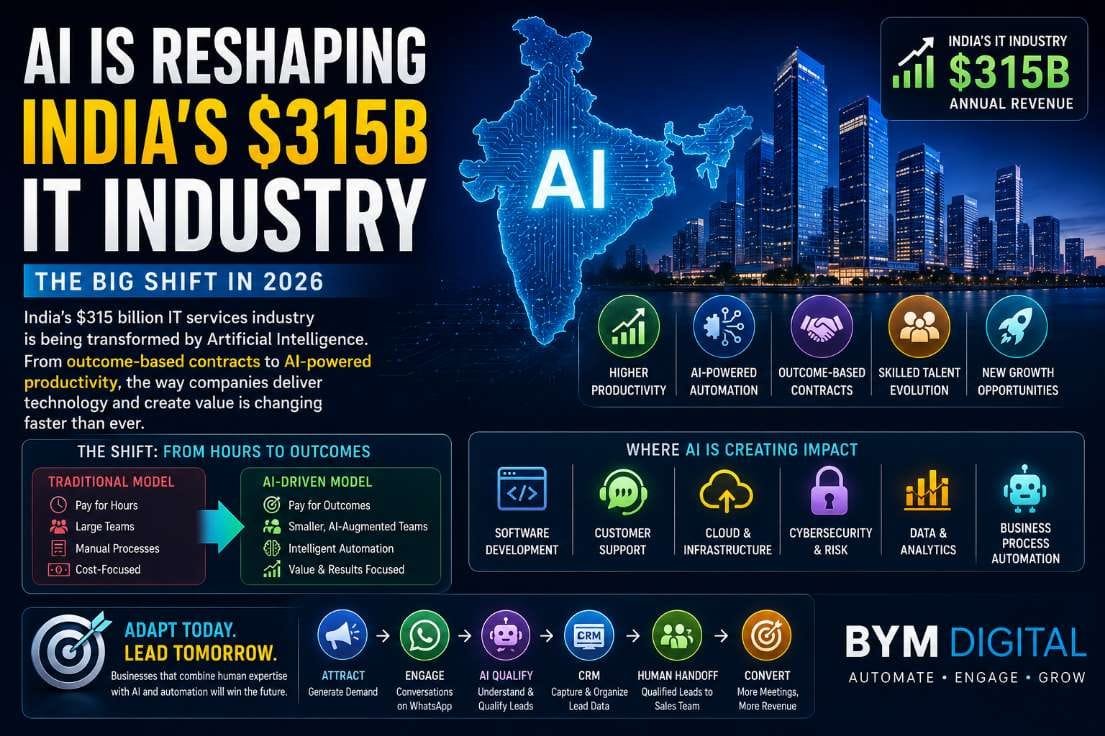
India's IT industry is entering one of its biggest transformations in decades. Artificial intelligence is no longer a technology experiment happening inside innovation labs—it is changing how technology companies price services, deliver projects, hire talent and compete for global customers.
According to recent Reuters reporting, India's IT services sector, valued at around $315 billion in annual revenue, is being reshaped by AI as clients demand more productivity, faster delivery and lower costs. Major technology companies including TCS, Infosys, Wipro, HCLTech and Cognizant are increasingly moving toward contracts tied to measurable business outcomes rather than simply billing for hours worked. :contentReference[oaicite:0]{index=0}
This is a fundamental change. For decades, India's technology-services advantage was closely connected to its enormous skilled workforce and cost-efficient delivery model. AI is now challenging that model—and creating a new opportunity at the same time.
Why AI Is Changing India's IT Business Model
The traditional IT outsourcing model was relatively straightforward: a client needed technology work, an IT company supplied people, and the customer paid based largely on the amount of work or number of employees involved.
AI changes the economics of that relationship.
If an AI-powered team can complete work faster with fewer people, clients naturally begin asking a different question: "Why should we pay for hours when we can pay for results?"
Reuters reports that companies are increasingly shifting toward performance and outcome-based contracts. TCS CEO K. Krithivasan told Reuters that about 80% of TCS contracts in its finance, HR and other business-services segment are now based on outcome-performance measures. :contentReference[oaicite:1]{index=1}
That signals a major transformation in how IT services could be sold globally.
From Billable Hours to Business Outcomes
The biggest change may not be AI replacing developers. It may be the way customers purchase technology services.
Instead of asking an IT provider to supply 100 developers for a project, companies may increasingly ask for a specific outcome: reduce processing time, automate customer support, migrate a system, improve conversion or reduce operational costs.
- Old model: Pay for people and hours.
- Emerging model: Pay for productivity and outcomes.
- Old competitive advantage: Scale and employee headcount.
- New competitive advantage: AI capability, speed, domain expertise and measurable results.
- Old sales pitch: "We have thousands of engineers."
- New sales pitch: "We can deliver this business outcome faster and more efficiently."
Why Smaller IT Companies Could Benefit
One surprising consequence of AI is that smaller technology companies may become more competitive.
Historically, large IT companies had a major advantage because they could deploy thousands of employees across massive global projects. But if AI increases the productivity of smaller teams, headcount becomes a less important measure of capability.
Reuters reported that mid-sized companies such as Persistent Systems and Coforge have been growing faster than several larger IT companies, while clients increasingly demand rapid pilots, flexible commercial terms and faster delivery. :contentReference[oaicite:2]{index=2}
This creates a new competitive environment where agility can matter more than size.
AI and the Future of IT Jobs in India
One of the biggest questions surrounding AI is what happens to India's millions of technology workers.
The answer is more complicated than "AI will take all the jobs." The immediate impact is likely to be a shift in the type of work companies need.
Routine coding, testing, documentation, basic support and repetitive business processes are increasingly suitable for automation. At the same time, demand can grow for people who understand AI systems, cloud infrastructure, cybersecurity, data, product strategy, automation and business processes.
NASSCOM has previously highlighted the need for large-scale reskilling as technology changes the IT-ITeS workforce. Its FutureSkills initiative identifies AI, cloud computing, cybersecurity, big data, automation and related technologies as important areas for future skills development. :contentReference[oaicite:3]{index=3}
The message for professionals is clear: the valuable skill is increasingly not just knowing how to perform a task, but knowing how to use technology to redesign the task.
India's IT Industry: Before vs After AI
| Area | Traditional IT Model | AI-Driven Model |
|---|---|---|
| Pricing | Hours and resources | Outcomes and productivity |
| Delivery | Large teams | Smaller, AI-augmented teams |
| Development | Human-led coding | AI-assisted development |
| Customer Support | Large support teams | AI + human support |
| Sales | Manual qualification | AI-assisted qualification |
| Reporting | Manual analysis | AI-powered insights |
| Competitive Advantage | Scale and cost | Speed, AI capability and outcomes |
AI Is Also Creating New Opportunities
It would be a mistake to view this transformation only through the lens of job losses and cost reduction. AI is also creating entirely new technology opportunities.
Indian businesses are increasingly investing in AI, cloud, cybersecurity, data platforms, automation and digital engineering. NASSCOM's FY2025 outlook estimated India's broader technology industry at more than $282 billion, with AI, cloud and digital engineering among important growth areas. :contentReference[oaicite:4]{index=4}
That means India's technology opportunity is not disappearing. It is changing shape.
- AI implementation and consulting
- AI-powered customer service
- Business process automation
- AI-powered software development
- Cybersecurity and AI security
- Cloud and AI infrastructure
- Data engineering and analytics
- AI-powered marketing and sales
- Industry-specific AI solutions
What This Means for Indian Business Owners
The impact of AI is not limited to IT companies. Every business that depends on technology, customer service, sales or repetitive operations should be asking how AI can improve its productivity.
A real-estate company can automate lead qualification. A healthcare business can automate appointment communication. An education company can automate enquiry management. A B2B company can use AI to qualify prospects before sending them to sales.
The important question is not "Should we use AI?" It is "Which business process should AI improve first?"
The New AI-Powered Business Workflow
A modern customer acquisition process can connect marketing, AI, CRM and sales into a single workflow.
- Advertisement: Generate demand through Google, Meta, LinkedIn or other channels.
- Conversation: Bring the prospect into WhatsApp or another preferred communication channel.
- AI Qualification: Ask questions and understand customer intent.
- CRM: Automatically capture and organize customer information.
- Lead Scoring: Identify high-value opportunities.
- Human Handoff: Send qualified prospects to the appropriate salesperson.
- Follow-Up: Automate reminders and relevant customer communication.
- Conversion: Move the customer toward a meeting, quotation, payment or purchase.
This is where the transformation becomes especially relevant for businesses outside the traditional IT industry. AI is becoming a layer that connects marketing, sales and operations.
What Indian Companies Should Do Now
Businesses should not respond to AI by buying every new AI tool that enters the market. A better strategy is to identify high-volume, repetitive and measurable workflows.
- Audit repetitive tasks across departments.
- Identify processes with high manual effort.
- Calculate the cost of slow response times and missed leads.
- Test AI on low-risk workflows first.
- Connect AI with CRM and business systems.
- Keep humans involved in high-value decisions.
- Measure revenue, productivity and customer experience—not just AI usage.
- Continuously reskill employees as workflows change.
How BYM Digital Can Help Businesses Adapt
The AI revolution is creating an opportunity for businesses of every size to become more efficient without building a huge technology department.
BYM Digital helps businesses combine digital marketing, WhatsApp automation, AI workflows and CRM processes to create connected customer journeys.
For example, instead of manually responding to every enquiry, a business can use an automated WhatsApp workflow to capture a lead, understand its requirement, qualify the prospect, update the CRM and alert a salesperson when human intervention is needed.
Explore the BYM Digital WhatsApp Automation solution to see how AI-powered customer communication can become part of your sales process.
If you want to identify which processes in your business can be automated, contact BYM Digital for an AI and automation strategy discussion.
Frequently Asked Questions
How is AI changing India's IT industry?
AI is changing India's IT industry by increasing productivity, automating repetitive work, changing hiring requirements and pushing technology companies toward outcome-based pricing models.
Will AI replace IT jobs in India?
AI is likely to automate some repetitive technology tasks while increasing demand for AI, cloud, cybersecurity, data, automation and business-focused technology skills. The bigger shift is expected to be in the nature of IT work rather than the disappearance of all IT jobs.
Why are Indian IT companies moving to outcome-based contracts?
AI allows technology teams to complete some tasks more efficiently, encouraging customers to demand greater productivity and measurable business results rather than simply paying for hours or employee headcount.
How can small businesses benefit from AI automation?
Small businesses can use AI automation for lead qualification, customer support, WhatsApp communication, appointment scheduling, CRM updates, follow-ups and other repetitive workflows.
Final Takeaway
India's IT industry is not simply adopting another new technology. It is undergoing a fundamental business-model transformation.
AI is changing how technology work is delivered, how contracts are structured, how employees are trained and how companies compete. India's historic advantage of scale and skilled talent remains important, but the next advantage will increasingly come from how effectively companies combine people, AI and automation.
For Indian businesses, the lesson is simple: do not wait until AI completely changes your industry. Start identifying the processes that can be made faster, smarter and more scalable today.
The future of India's IT industry will not be AI versus humans. It will be businesses that know how to make humans and AI work better together.