Gemini 3.8 Flash vs 3.7 Flash: Why Users Are Switching Back
 BYM Digital
•
October 8, 2026
•
9 min read
BYM Digital
•
October 8, 2026
•
9 min read
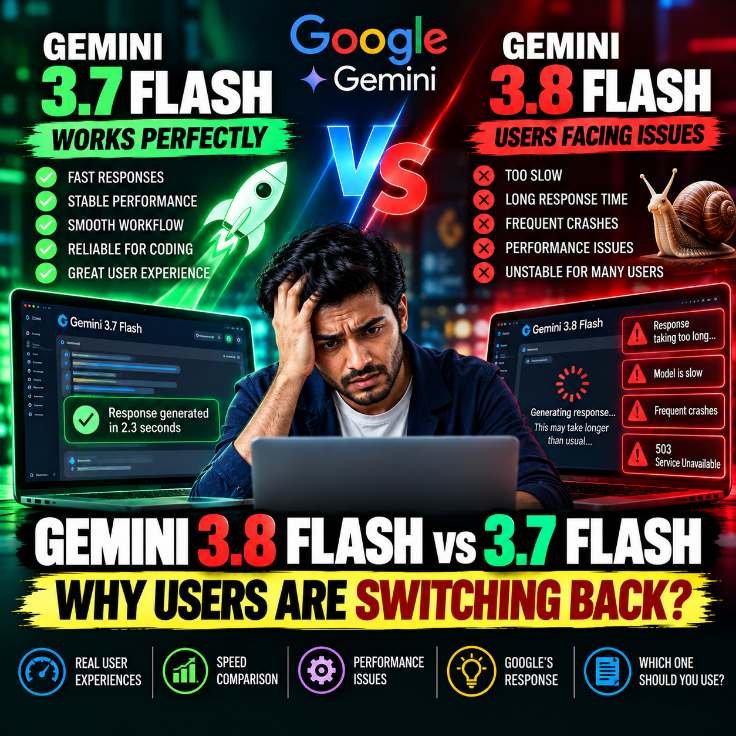
Gemini 3.8 Flash vs 3.7 Flash: Why Are Users Switching Back?
Google's Gemini Flash lineup has become one of the most closely watched AI model families for developers, creators and businesses. But the latest upgrade is creating an unusual debate: Is Gemini 3.8 Flash actually better for everyday work than Gemini 3.7 Flash?
Gemini 3.8 Flash is officially the newer and more capable model. Google says it delivers improvements in software engineering, agentic workflows, complex reasoning and enterprise tasks.
But performance is not only about intelligence.
For people using AI coding tools, agents and interactive workflows, speed, latency, reliability and responsiveness matter just as much as benchmark scores.
That is where the Gemini 3.8 versus 3.7 debate gets interesting.
What Is Happening With Gemini 3.8 Flash?
Since the launch of Gemini 3.8 Flash, users have reported situations where the model feels considerably slower than Gemini 3.7 Flash, particularly inside agentic development environments.
Some users describe long waits before the model starts responding, slow progress between tool calls and workflows that take substantially longer than they did with 3.7.
Google's own documentation provides an important clue: Gemini 3.8 Flash is designed to work harder on complex tasks. It can perform additional reasoning steps, make iterative tool calls and verify its work before producing a result.
That can improve quality, but it can also increase latency and token consumption.
Gemini 3.8 Flash Is Not Simply a 'Bad' Model
It is important not to confuse slower responses with lower intelligence.
Google's published evaluations show Gemini 3.8 Flash improving over Gemini 3.7 Flash across several demanding benchmarks, including long-horizon software engineering, knowledge work and financial-agent tasks.
Independent testing also currently shows 3.8 Flash achieving a higher intelligence score than 3.7 Flash.
The problem is that higher intelligence does not automatically mean a better user experience.
If a developer has to wait significantly longer for every tool call, the additional intelligence may not be worth the extra waiting for simple tasks.
The Biggest Difference: Speed vs Reasoning
This is arguably the biggest difference between the two models.
Gemini 3.7 Flash can be attractive when the priority is fast interaction and efficient execution.
Gemini 3.8 Flash is designed to spend more effort on difficult tasks, especially complex coding, autonomous agents and multi-step workflows.
In simple terms:
- Gemini 3.7 Flash: Faster and more responsive for many workflows.
- Gemini 3.8 Flash: More reasoning-intensive and potentially stronger on complex tasks.
- The trade-off: More reasoning can mean more latency and more token usage.
Independent Tests Show a Real Speed Gap
Independent model measurements currently show a meaningful responsiveness difference between the two models at high reasoning effort.
Artificial Analysis reports Gemini 3.7 Flash generating substantially more tokens per second than Gemini 3.8 Flash High, while also showing lower time-to-first-token for 3.7.
This does not mean every user will experience exactly the same numbers. Performance can vary depending on the platform, workload, reasoning level, traffic and infrastructure.
But the measurements support something users have been reporting: 3.7 can feel noticeably faster.
Google Has Acknowledged 3.8 Performance Problems
This is where the discussion becomes more significant.
In September, a thread on Google's AI developer forum reported severe performance degradation affecting Gemini 3.8 Flash in Antigravity.
A Google forum representative said the engineering team was aware of the problem and was investigating the performance degradation. The same response said that switching the active model to Gemini 3.7 Flash restored normal execution speeds for many users as a temporary workaround.
A separate report documented severe latency and time-to-first-token problems, with the thread later receiving a response that the known issue had been resolved.
This is important because it shows that at least some of the extreme slowdowns were not simply users imagining a difference between the models.
But The Problems Did Not End There
Later reports from the Google AI developer community described additional slowdowns and 503 capacity errors affecting Gemini 3.8 Flash during certain periods.
One September report described major slowdowns during peak hours and repeated 503 UNAVAILABLE responses. A Google forum response attributed those errors and slowdowns to high concurrent traffic spikes on the Gemini 3.8 Flash High serving pool rather than intentional throttling.
This distinction matters.
There are at least two different issues that users can experience:
- Model-level latency: 3.8 may take more reasoning steps and use more tokens.
- Infrastructure-level degradation: temporary server capacity or traffic problems can make an otherwise fast model extremely slow.
Why Gemini 3.7 Flash Can Feel Better
For everyday coding and interactive work, responsiveness changes the entire experience.
Imagine asking an AI agent to change a button on a website.
If the model understands the request immediately, reads only the necessary files and makes the change quickly, the workflow feels almost instantaneous.
But if the newer model spends a long time examining files, reasoning through multiple possibilities and repeatedly calling tools before making a small change, the user may feel that the model is unnecessarily slow.
That is especially frustrating when the task itself is simple.
3.8's 'Works Harder' Approach Is Both Its Strength and Weakness
Google describes Gemini 3.8 Flash as a model that works harder on complex tasks.
That approach can be extremely useful for difficult software engineering problems where additional reasoning prevents mistakes.
But it can be inefficient for simple tasks.
Google's own API documentation recognizes this trade-off. It recommends lower reasoning effort when latency matters and says Gemini 3.7 Flash can still be used when compute efficiency is the priority.
What About Crashes and Errors?
Reports of crashes, timeouts, quota errors and unexpected failures should be treated separately from the model's intelligence.
Some recent Google AI community reports describe users experiencing long-running tasks, repeated quota errors and unexpected failures in AI Studio or agentic environments.
However, not every reported failure is necessarily caused by Gemini 3.8 itself. Platform bugs, account limits, traffic spikes, tool integrations and backend infrastructure can all contribute.
For this reason, it is more accurate to say that users are reporting reliability and latency problems rather than claiming that Gemini 3.8 universally crashes or fails.
Why People Are Comparing 3.8 With 3.7 So Aggressively
The comparison is unusual because Gemini 3.8 Flash is supposed to be an upgrade.
Users naturally expect a newer model to be faster, smarter and more reliable.
Instead, the real-world experience can look more complicated:
- Better reasoning on difficult tasks.
- Better coding performance on several benchmarks.
- More extensive tool use.
- Potentially higher token consumption.
- Higher latency in some workflows.
- Infrastructure-related slowdowns at certain times.
- 3.7 remaining attractive for speed-focused workloads.
Gemini 3.8 Flash vs 3.7 Flash: Which One Should You Use?
There is no universal winner.
Use Gemini 3.7 Flash When:
- You prioritize fast responses.
- You are doing simple coding changes.
- You need quick interactive conversations.
- You are working on latency-sensitive workflows.
- You want lower reasoning overhead.
- Your current 3.7 workflow is already reliable.
Use Gemini 3.8 Flash When:
- You are solving difficult coding problems.
- You need deeper multi-step reasoning.
- You are building autonomous agents.
- You need complex tool orchestration.
- You are working on long-horizon software engineering tasks.
- Accuracy matters more than immediate response speed.
The Smart Strategy: Don't Automatically Upgrade Everything
This may be the biggest lesson for businesses and developers.
A new AI model should not automatically replace a model that already works well.
Before moving a production workflow from Gemini 3.7 to 3.8, test both models on your actual workload.
Measure:
- Time to first response.
- Total task completion time.
- Number of tool calls.
- Tokens consumed.
- Error rate.
- Successful task completion rate.
- Human correction required.
- Overall cost per completed task.
The best model is not necessarily the one with the highest benchmark score. It is the model that delivers the best combination of quality, speed, reliability and cost for your specific workflow.
What Businesses Should Learn From the Gemini 3.8 Debate
The Gemini 3.8 versus 3.7 debate is bigger than Google.
AI systems are becoming increasingly complex. Modern models can reason, use tools, inspect files, call APIs and perform multi-step actions.
That means businesses need to start evaluating AI like they evaluate other production technology.
Don't ask only, 'Which AI model is smartest?'
Ask:
- How quickly does it respond?
- How reliable is it?
- How much does each completed task cost?
- How often does it need human intervention?
- Does it actually improve productivity?
The Bottom Line
Gemini 3.8 Flash is not a failed upgrade. Google has demonstrated meaningful improvements in reasoning, coding and agentic capabilities, and independent evaluations show that it can outperform 3.7 on intelligence-oriented measurements.
But the criticism around speed should not be dismissed either.
Users have reported significant latency problems, Google has acknowledged performance degradation in its developer community, and independent measurements show that Gemini 3.7 Flash can be substantially faster in certain configurations.
For developers who need maximum reasoning capability, 3.8 may be worth the trade-off.
For developers who need fast, responsive execution, Gemini 3.7 Flash may still be the better practical choice.
The real question is no longer simply 'Is Gemini 3.8 better?'
It is:
'Is Gemini 3.8 better for the work I actually need it to do?'
That is the test every AI user should run before switching models.
FAQs
Is Gemini 3.8 Flash slower than Gemini 3.7 Flash?
In current independent measurements, Gemini 3.7 Flash can be significantly faster than Gemini 3.8 Flash at high reasoning effort. However, real-world speed depends on the workload, platform, reasoning level and infrastructure.
Why does Gemini 3.8 Flash feel slower?
Google says Gemini 3.8 Flash can use more tokens and perform additional reasoning and tool calls on complex tasks. That can improve quality but increase latency.
Should I switch back to Gemini 3.7 Flash?
If speed and responsiveness are more important than maximum reasoning capability for your workflow, testing Gemini 3.7 Flash is reasonable. Google continues to support 3.7 Flash.
Is Gemini 3.8 Flash better than 3.7?
For complex reasoning, software engineering and agentic tasks, Gemini 3.8 Flash shows meaningful improvements in Google's evaluations. However, 3.7 can be faster and more efficient for workflows where responsiveness is the priority.
Are Gemini 3.8 crashes caused by Google?
Not every crash or error has the same cause. Users have reported latency, timeout and capacity problems, while some issues have been acknowledged by Google's developer community. Infrastructure, platform bugs, quotas and model behavior can all contribute to failures.
What is the best Gemini model for coding?
It depends on the coding task. Gemini 3.8 Flash is designed for complex, long-horizon software engineering, while Gemini 3.7 Flash can be attractive when fast iteration and responsiveness are more important.
Want to use AI automation without depending on a single model? Contact BYM Digital to discuss an AI and automation strategy for your business.