You Don't Need Elon Musk's Technology to Beat Competitors
 BYM Digital
•
October 16, 2026
•
7 min read
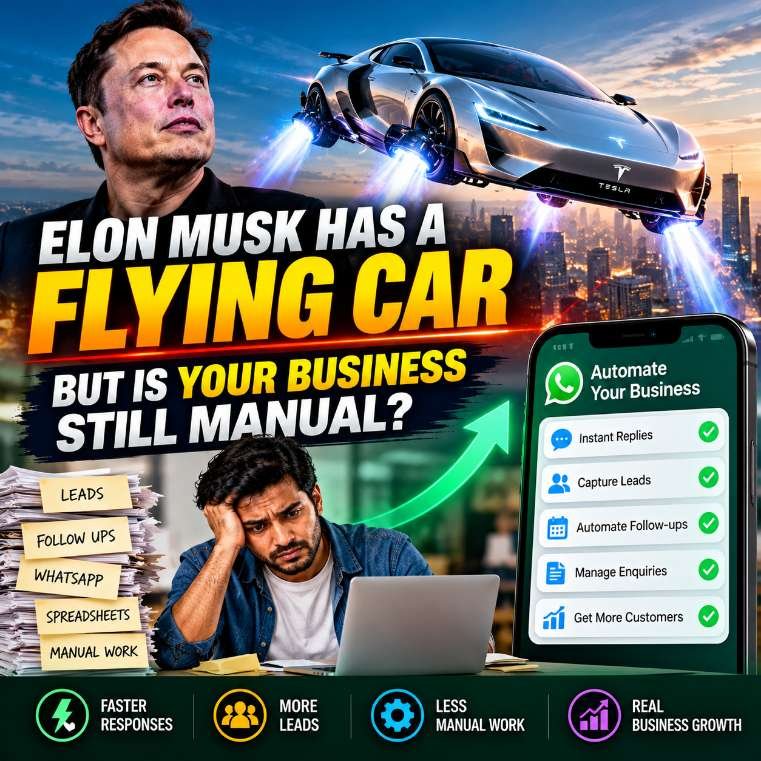
You Don't Need Elon Musk's Technology to Beat Your Competitors
Elon Musk's latest Tesla Roadster demonstration has put futuristic automotive technology back in the spotlight. The vehicle was demonstrated with rocket-style thrusters capable of dramatic aerial manoeuvres, showing how far engineering ambitions can go. However, the demonstration does not mean flying cars are now widely available for everyday use.
Read the report on Elon Musk's Tesla Roadster demonstration.
But this story raises an interesting question for business owners: while the world talks about futuristic technology, are you still losing customers because your business takes too long to respond to an enquiry?
You do not need a rocket-powered car, a massive research budget, or a team of engineers to improve your competitive position. Sometimes, the advantage comes from responding to customers faster, following up consistently, and removing repetitive work from your team's day.
Here is how businesses can apply that lesson.
1. Your Biggest Competitor May Be Your Own Slow Process
Imagine a customer enquires about a property, a course, a service, or a product. They contact three businesses on WhatsApp. One responds within minutes, another replies several hours later, and the third never follows up.
Even if your product is excellent, a slow response can make a potential customer look elsewhere. The first business has an opportunity to understand the customer's needs, answer questions, and move the conversation forward.
This does not mean the fastest business always wins. Pricing, quality, reputation, and customer fit matter too. But a reliable response process can help prevent avoidable missed opportunities.
The takeaway: Before investing in complicated new technology, examine where your business is losing time and customer attention.
2. Stop Letting Valuable Leads Disappear
Many small businesses receive enquiries through websites, social media, phone calls, and WhatsApp. The challenge begins when those enquiries are managed across disconnected inboxes, spreadsheets, and personal reminders.
A lead might be forgotten because a team member is busy. Another customer might never receive the promised quotation. Someone who asked for more information may be interested but needs a timely follow-up.
A more organised process can help your team:
- Record new enquiries in one place.
- Assign conversations to the appropriate team member.
- Track which leads need a response.
- Schedule follow-ups instead of relying entirely on memory.
- Identify which marketing channels generate useful enquiries.
The objective is not to automate every conversation. It is to make sure promising opportunities do not disappear because the process is disorganised.
3. Use WhatsApp Automation to Improve Customer Communication
For businesses that already receive customer enquiries through WhatsApp, automation can help manage repetitive parts of the conversation.
Depending on the tools and setup, businesses may be able to automate welcome messages, provide frequently requested information, route enquiries, collect basic details, and support follow-up workflows.
For example, a coaching institute could acknowledge a course enquiry and share the relevant course details. A real estate team could collect a preferred location and budget before assigning the enquiry to an agent. An online business could provide order information or direct customers to the right support channel.
These workflows can reduce repetitive manual work while helping customers understand what happens next. Complex questions and sensitive situations should still be directed to a person when appropriate.
Explore BYM Digital's WhatsApp automation service to learn how WhatsApp workflows can support business communication.
4. Automate Repetitive Tasks, Not Human Relationships
Automation works best when it handles predictable, repetitive steps and gives people more time for work that requires judgement.
Consider tasks such as acknowledging a new enquiry, sending an approved information message, notifying a salesperson about a new lead, or reminding a team member that a follow-up is due. These are often good candidates for a structured workflow.
By contrast, negotiating a complex deal, resolving a complaint, or understanding an unusual customer requirement may require human attention.
A practical automation strategy asks three questions:
- Is this task repeated frequently?
- Can the process be defined clearly?
- Can it be automated without making the customer experience worse?
If the answer to all three is yes, the task may be worth evaluating for automation.
5. Make Your Digital Marketing Work Harder
Getting more website visitors is only one part of growing a business. You also need to understand whether those visitors become enquiries and customers.
A more effective digital marketing process connects campaigns with what happens after someone clicks. Businesses can review landing-page performance, track enquiries, improve calls to action, and assess which channels produce relevant leads.
For example, if a campaign generates many enquiries but few qualified prospects, the answer may not be to increase the advertising budget. The business may need clearer messaging, a better landing page, faster responses, or a more suitable follow-up process.
SEO, paid advertising, useful content, and customer communication work best when they support the same business objective.
6. Measure the Results Instead of Following Every Trend
Not every new technology is the right investment for every business. The smartest approach is to start with a specific problem and measure whether the proposed solution improves it.
Before introducing an automation workflow, establish a baseline. You could track:
- Average time taken to respond to new enquiries.
- Percentage of enquiries receiving a follow-up.
- Number of qualified leads generated.
- Conversion rate from enquiry to customer.
- Time spent on repetitive administrative tasks.
Review the results after implementation. If response times improve but conversions do not, investigate other factors such as pricing, lead quality, or the sales process. Automation is a tool, not a guarantee of business growth.
7. What Small Businesses Can Learn From Elon Musk's Approach
One lesson from ambitious technology projects is the importance of challenging assumptions about what is possible. Businesses can apply that mindset without copying every new invention or spending beyond their means.
Start by identifying a frustrating process. Talk to the people who handle it every day. Find the repeated steps, test a practical improvement, and measure the result. Expand the solution only when it demonstrates value.
A small improvement repeated across hundreds of customer interactions can be more useful than an expensive technology project that does not solve a real problem.
Your Business Doesn't Need a Flying Car. It Needs a Better System.
Elon Musk's Tesla Roadster demonstration is a reminder of how dramatically technology can evolve. But your business does not need to compete in aerospace engineering to become more efficient or deliver a better customer experience.
You can start with the basics: respond to enquiries promptly, organise your leads, follow up consistently, improve your digital marketing, and automate repetitive tasks where it makes sense.
These improvements will not guarantee that you beat every competitor. They can, however, help you build a more consistent process for serving customers and managing opportunities.
At BYM Digital, we help businesses explore digital marketing and WhatsApp automation to improve customer communication and streamline repetitive workflows.
Want to explore what could work for your business? Visit our WhatsApp automation service page or contact BYM Digital to discuss your requirements.
Frequently Asked Questions
What is business automation?
Business automation uses software and defined workflows to handle repetitive tasks, such as routing enquiries, sending approved notifications, updating records, or reminding teams about follow-ups.
Can WhatsApp automation help a small business?
It can help businesses manage recurring customer communication, provide timely acknowledgements, organise enquiries, and support follow-up processes. The benefits depend on the business's needs, implementation, and customer experience.
Does business automation replace employees?
Automation can reduce manual work for certain repetitive tasks, but it does not replace the judgement, empathy, and problem-solving required in many customer interactions. A useful implementation supports employees rather than removing human assistance where it is needed.
How should a business start with automation?
Choose one repetitive process, document how it works today, identify a measurable improvement, and test a suitable tool on a small scale. Review the results before expanding.
Is Elon Musk's Tesla Roadster a commercially available flying car?
The October 2026 event demonstrated a Tesla Roadster prototype equipped with rocket-style thrusters. Production timing, regulatory approval, and the practical availability of the demonstrated capabilities remain important considerations. It should not be described as a widely available, approved flying car.